For In-Country Value Oman tenders, prepare for local content requirements covering Omani workers, local products and SME participation. In-Country Value (ICV) is the common English term; official government tender texts use "local content" (المحتوى المحلي). The regulation covers all contracts subject to the Tender Law. The application guide's requirements enter tender documents "all or some", depending on the project, so those documents decide what applies. See the local content regulation and application guide.
Start with the tender documents:
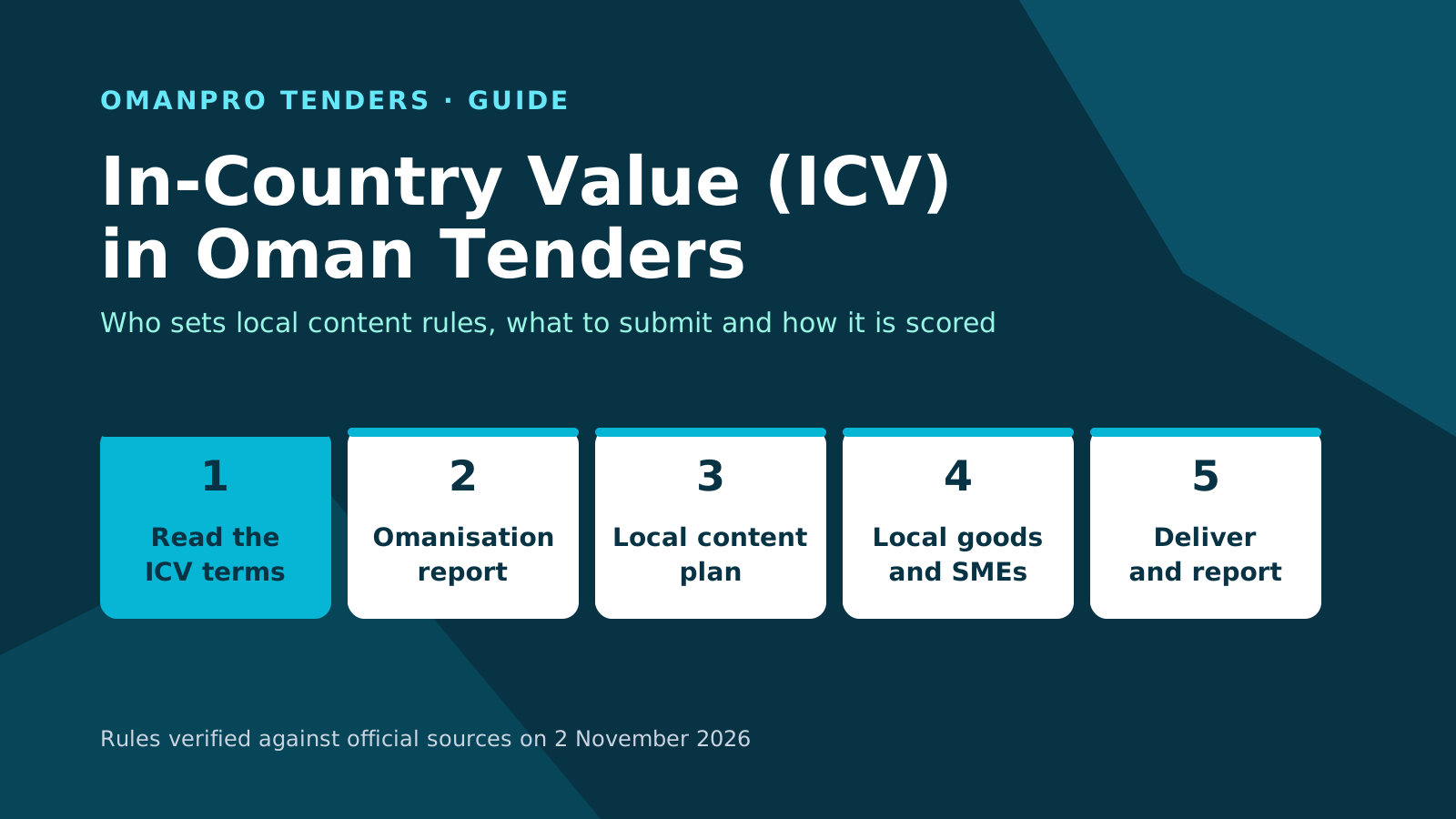
- Identify the local content requirements, mandatory products and evaluation method.
- Prepare the local content plan, Omanisation report and required forms.
- Check the submission instructions, including the technical and financial copies where applicable.
- Review the delivery commitments and reporting duties before submitting your bid.
These checks follow the regulation and application guide. For the wider process, read how to bid on Oman government tenders. Consult the bid bond and tender fees guide for those separate requirements.
Who sets ICV requirements?
The Directorate General of Local Content sets requirements for contracts above OMR 3,000,000. For contracts from OMR 500,000 to OMR 3,000,000, it may review requirements prepared by the contracting entity, depending on the contract's nature. When floating a tender, the Directorate and entity set mandatory products, the evaluation mechanism and the mechanism for weighting local content in financial evaluation. See the regulation.
The Projects, Tenders and Local Content Authority sets sector targets, measures local content and reviews requirements under its mandates. Its directorate page uses the English title "DG of In Country Value (ICV)". Its listed mandates include preparing local content requirements for privatisation projects, contracts, procurement and tenders, and setting requirements and targets for government procurement and projects.
Decision 174/2023 issued the regulation on 6 December 2023, with publication in Official Gazette 1525 and effect from the following day. It uses the earlier name, Secretariat General of the Tender Board. Read the Authority guide for institutional context, and confirm tender-specific questions with the Authority.
What counts as local content?
The regulation defines local content as value added to the national economy through elements including workers, national and local products, fixed assets and SME development. Depending on the project, requirements must cover national workforce development and jobs, and local sourcing through value chain and supply chain analysis. Entities may also require investment in facilities and machinery.
A local product is a good or service made inside Oman. A national product also holds the national product identity from the Ministry of Commerce, Industry and Investment Promotion. The mandatory list identifies national products that must be used in the contract. The Secretariat General issues and updates it; contracting entities must comply with it. These distinctions come from the regulation.
The application guide gives a sourcing order: mandatory-list factories in Oman first, with priority to SMEs, then local factories for goods outside the list, then locally registered suppliers for imports. If buying abroad is necessary, the project's local content manager asks the entity for an exception with reasons. Services follow the same order.
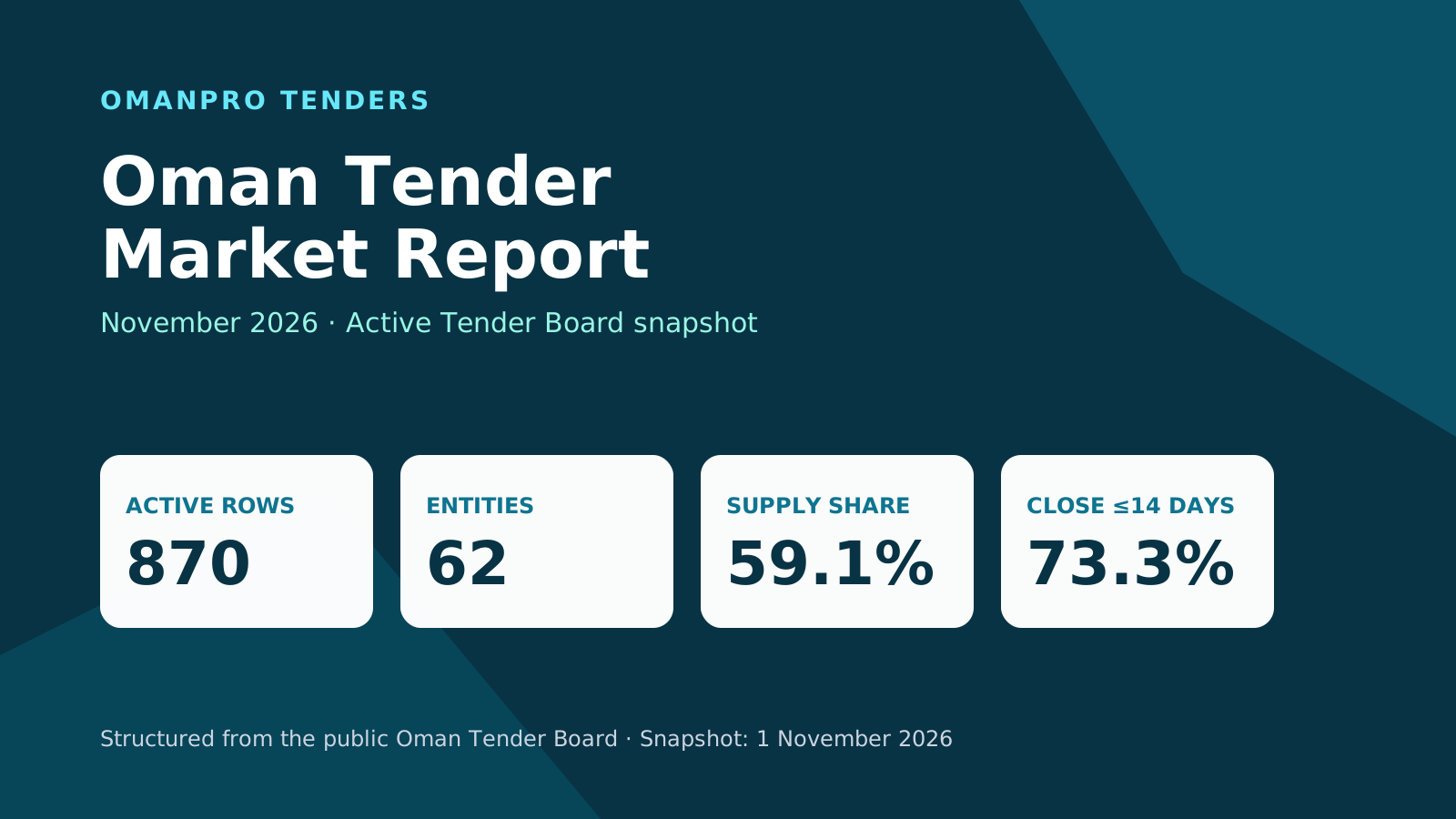
In the 1 November 2026 hub snapshot, 97 construction and maintenance tenders were open, 27 of them closing within 7 days, and 22 international tenders were open.
What to submit with your bid
Under the regulation, bidders must submit a local content plan covering all project phases and include it in any subcontracts. The Directorate may also require a local content certificate for evaluation, requested from the Secretariat General on its form. Check whether your tender requires it.
For the applicable requirements, the application guide specifies:
- The Ministry of Labour Omanisation report for the three categories, dated no earlier than 3 months before bid submission, plus the workforce form.
- A training plan for Omanis. Training costs are not included in the project cost.
- The completed local content requirements form.
- A statement of work to be subcontracted to SMEs.
The workforce requirement also includes following Ministry of Labour Decision 235/2020 on jobs reserved for Omanis. For projects above OMR 3 million, the bidder must also appoint an Omani local content manager. In two-envelope tenders, local content requirements go in the technical offer without values; a copy with values and percentages goes in the financial offer. An unfilled form may lead to exclusion without a clarification request or a change to the bid value. See the application guide.
The same guide calls for SME work of not less than 10% of the award value, or the percentage in the tender plan or project. All subcontract works are floated through Esnad. Freelancer contracts may not exceed 10% of the bid value. For related context, read the SME tenders and Riyada card guide.
How local content is evaluated
The entity or Secretariat General chooses between direct exclusion for incomplete data or failure to meet the minimum local content level, and scoring each item to compare bids. Higher company and project Omanisation rates receive higher preference and scores. A plan training more Omanis receives a higher score. These methods are in the application guide.
The guide allows a price preference of up to 20% for SMEs according to the project, and also for local companies in internationally floated tenders. SMEs may receive extra evaluation points. Separately, qualifying SME national products receive a price preference of up to 10% under the Tender Law. Check which provision and conditions your tender applies.
There is no fixed local content weight to assume across tenders. The evaluation guideline treats local content as a technical criterion covering Omanisation, training, local products and SME work, with points divided according to project priorities. Read the tender's actual weights and financial evaluation mechanism.
After award
The application guide requires a detailed local content plan within 15 working days of notification that the bid was accepted, followed by execution reports every three months. A bidder may request an exception from an item it cannot apply, giving reasons; a refused request scores zero for that item.
The entity supervises delivery. For contracts above OMR 3,000,000, the contractor must immediately notify the Directorate of difficulties and obtain approval for corrective measures. For contracts up to OMR 3,000,000, the entity approves them. Entities send quarterly compliance reports, and the Directorate may conduct an annual audit. The Secretariat General may amend the plan by agreement with the entity and awarded contractor; its formula calculates the agreed percentage. See the regulation.
The application guide lists penalties including a ban from tenders and government procurement for a period set by the Tender Board, deduction of unmet items' cost plus a monthly OMR 500 fine until compliance, and suspended payments until reports are submitted. Failure to follow sourcing priorities also leads to deduction of the goods' value from payments. Confirm how these provisions appear in your tender documents.
Check your tender match
Start with the tender match check for your business, then confirm local content requirements in the tender documents, on Esnad or with the Authority.
For wider market context, read the Oman tender market report.
Sources
The sources below were verified on 2 November 2026:
- Decision 174/2023 issuing the Regulation Governing Local Content.
- Guide to applying local content in government projects and contracts.
- Guideline for the evaluation of tenders, issue 1.
- Circular 9/2024 issuing guides supporting local content.
- Authority local content directorate, DG of In Country Value (ICV).
- Royal Decree 57/2025 on the Authority's name, mandates and structure.
- Tender Law issued by Royal Decree 36/2008, consolidated edition published in 2020.
OmanPro is independent of the official authorities; the official texts prevail.