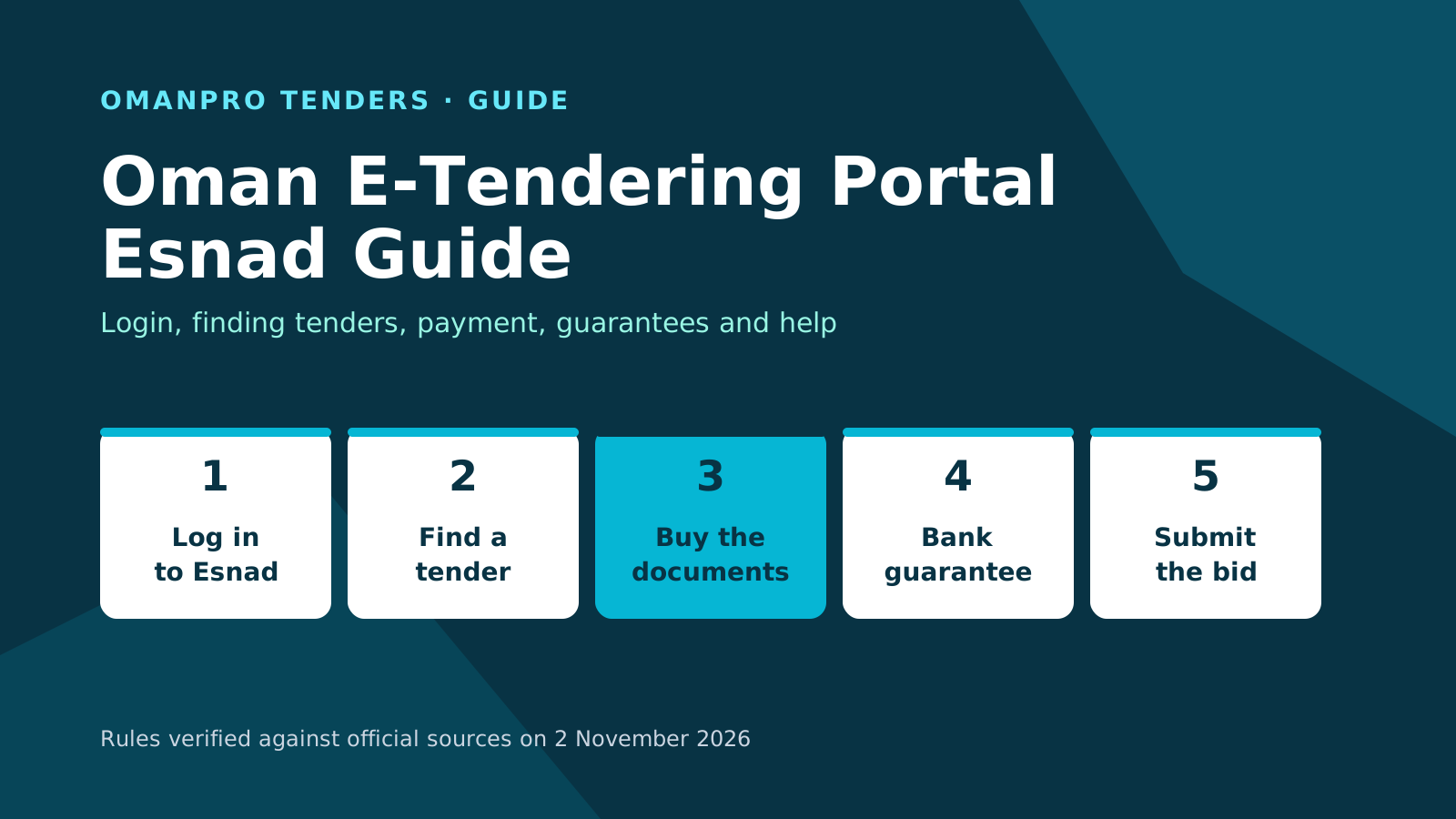
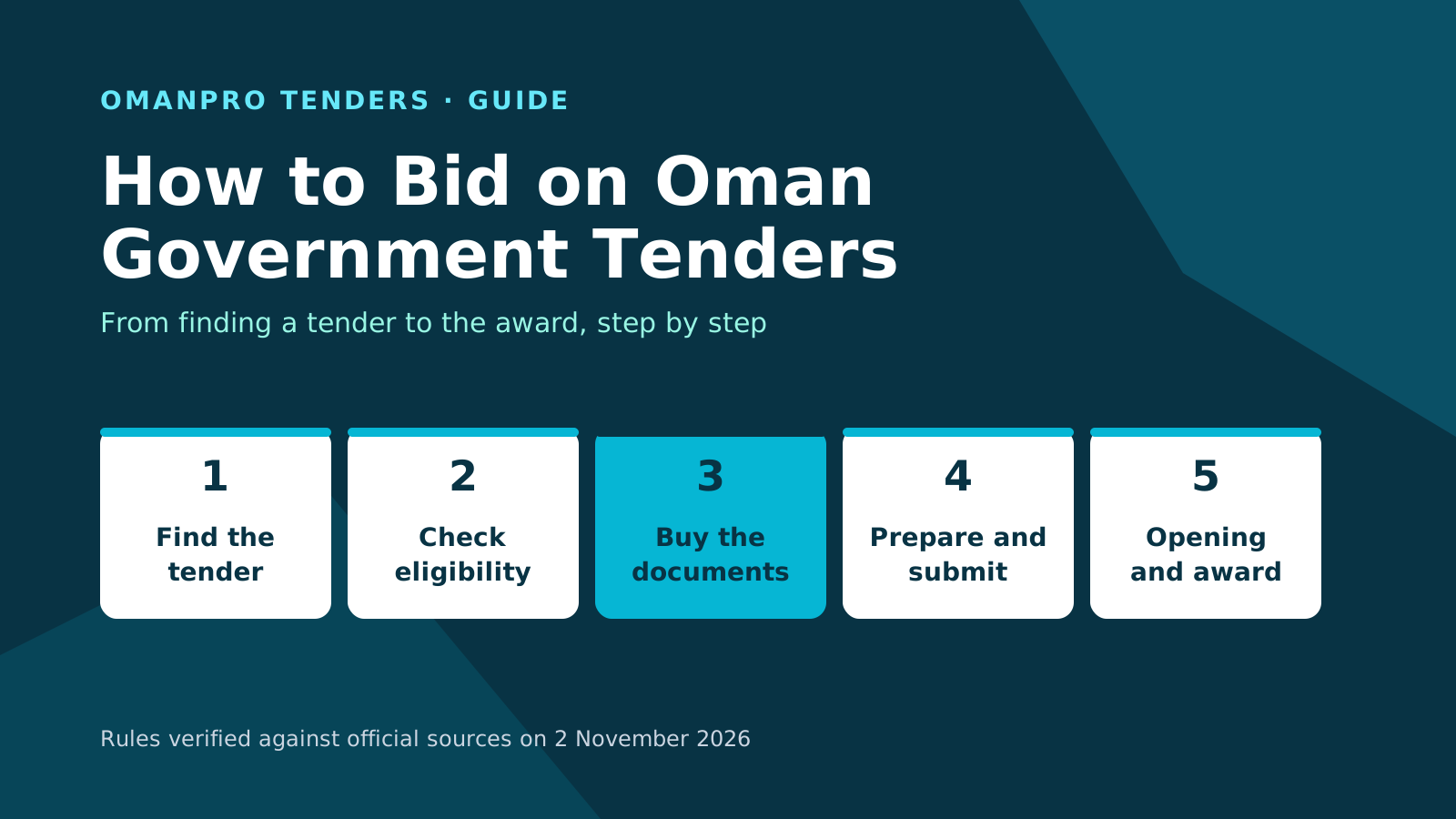
To bid on government tenders in Oman, find the tender on Esnad, check your registration and accepted grade, and buy the tender documents before the document sales end date. Prepare your bid and submit it with any bid bond the notice requires before the closing date. Envelope opening follows, then evaluation and award. Start by reading the notice for the tender you want to enter.
Find a tender on Esnad
Government tenders are publicly listed on the Esnad tender portal. The Tender Board's Secretariat General is now the Projects, Tenders and Local Content Authority, though searchers still call it the Tender Board.
Article 18 of the Tender Law provides for notices in a widely circulated daily newspaper in Arabic and English, with electronic publication also permitted. Tenders above OMR 500,000 are also published in the Official Gazette.
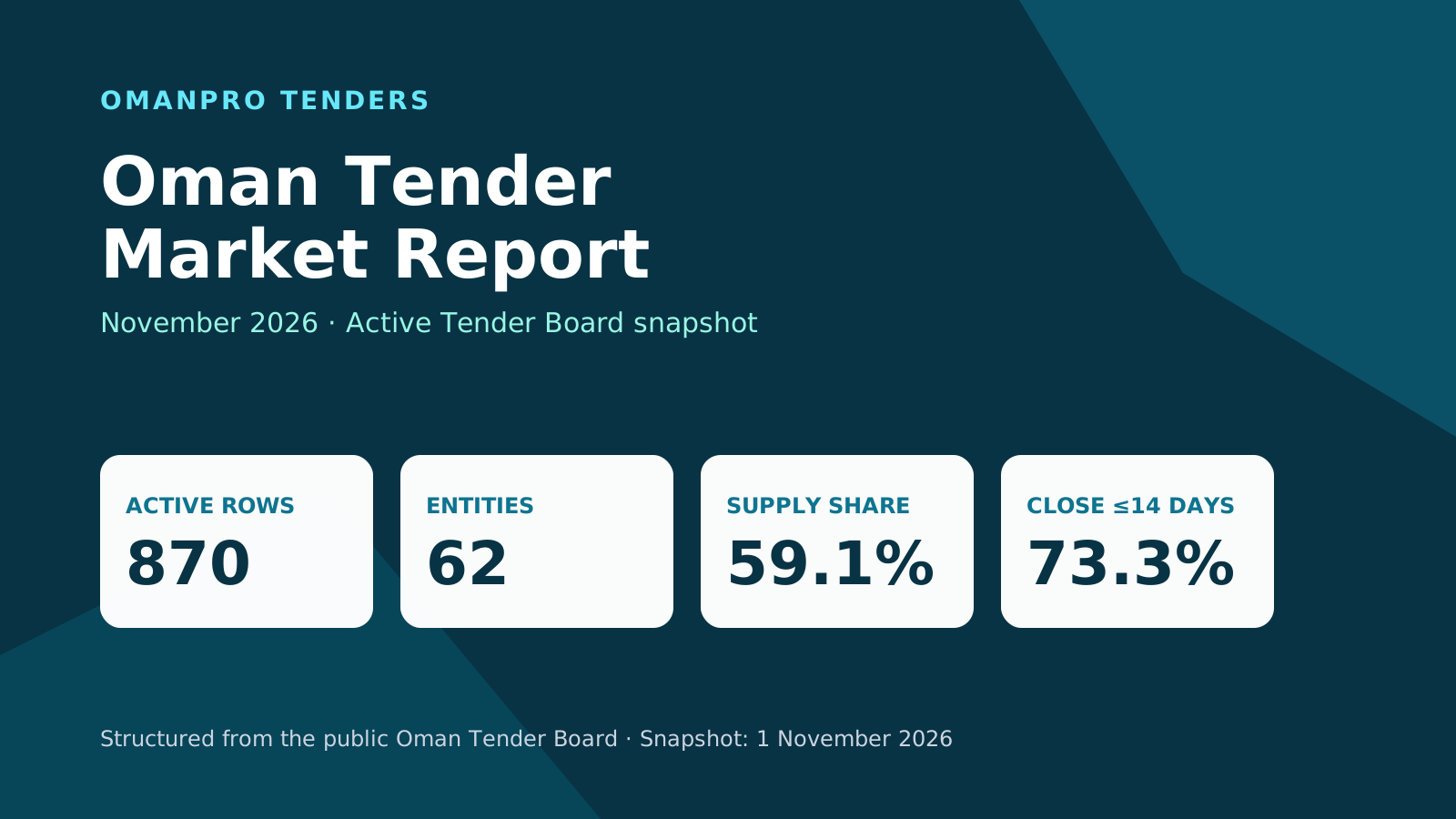
Browse the Oman tender index and this week's tenders, or start with supply tenders if that is your activity. In the 1 November 2026 hub snapshot, documents were still on sale for 467 of 870 open tenders.
Read the notice for the required goods, works or services, how and where to submit, the submission date, bid validity, document price and where to obtain the documents, and required guarantees. Article 18 of the Executive Regulation of the Tender Law requires these details.
Check registration and eligibility
Under Article 16 of the Tender Law, local tenders are limited to businesses entered in the commercial register or a professional register specified by the Board. International tenders may admit foreign companies not registered in Oman. Article 41 excludes unregistered bidders except international companies entering international tenders. Under Article 23, those companies must register within 30 working days of notification that their bid was accepted.
A classification certificate allows its holder to compete in government project and procurement tenders. Compare your certificate with the notice's accepted grades. Read the contractor classification guide, then browse Fourth-grade tenders if relevant to your registration.
The Authority's Esnad FAQ says a tender appears in your account only when your main field, sub-field and grade match, the tender type matches, and document sales have not ended. Check the type as well, whether local, SME or practice. Confirm any eligibility requirement not covered here in the notice or on Esnad.
Buy documents before sales end
The public list shows a document sales end date and a bid closing date. Treat them as separate deadlines: buy before sales end, then submit before bid closing. A later bid closing date does not mean documents remain available to buy. The sales deadline also explains why a tender can disappear from your Esnad account.
Article 19(a) of the Executive Regulation says documents are issued after you pay their price. Confirm the exact price in OMR in the notice or on Esnad.
Article 19 of the Tender Law gives bidders at least 40 days from the first notice to submit. On the entity's request, the Board may shorten that period to no less than 15 days in the cases set by the regulation. Use the published dates for your tender rather than calculating a deadline from the general rule.
If a tender is cancelled before the envelope opening date, Article 40 of the Tender Law provides for refunding the document price on return of the complete documents. After that date, only those who submitted a bid receive the refund.
Ask questions and watch for changes
Under Article 19(b) of the Executive Regulation, your questions must reach the Board or the entity at least 21 days before bid submission. Answers go to all bidders and must give no bidder an advantage. Confirm the question submission method on Esnad.
Article 21 of the Executive Regulation requires changes made after document distribution to reach all document buyers at least 15 days before bid submission. Review those changes alongside the documents when preparing your offer.
Prepare the bid
Article 24 of the Tender Law requires compliance with the notice and tender documents. Under Article 29 of the Executive Regulation, submitting your bid acknowledges that you have read all conditions and specifications.
Before submitting:
- Follow the tender's technical and financial offer instructions. Article 26 of the Tender Law provides for one envelope unless the Board requires separate envelopes for that tender. Confirm the electronic submission arrangement on Esnad.
- Attach the names of those authorised to contract for you, the scope of their authority and certified signature specimens, as required by Article 26 of the Executive Regulation.
- Write prices in OMR, in figures and words. Article 31(a) of the Executive Regulation permits a bid from outside Oman in a foreign currency if it states the exchange rate to OMR.
- Check unit prices, totals and wording. Under Article 43 of the Executive Regulation, the unit price prevails over the total and words prevail over figures.
- Check that documents are complete, signed and stamped. Article 41 of the Tender Law excludes incomplete, unsigned or unstamped bids, as well as bids without the full bid bond where the tender requires one.
Check the bid bond requirement and bid validity
The tender notice and listing state whether a bid bond is required and how much. Check both for every tender. Do not assume a bond is always required or never required. Article 43 of the Tender Law sets a bid bond of at least 1% of the total bid value. Article 41 excludes a bid without the full bond where one is required. Circular 1/2023 exempted companies from the 1% bid bond under conditions. The company must sign an undertaking to keep its bid, and withdrawing before bid validity ends leads to a one-year bar from government tenders. Circular 1/2024 extended the exemption until work on developing the Tender Law is finished. The circular still requires the bond in two cases. The first is tenders with an estimated cost above OMR 3,000,000 whose annual economic return exceeds 10% of that cost. The second is international companies with no base in Oman bidding in international tenders, except tenders to supply medicines and medical supplies.
Where a bond was provided, it is forfeited if you withdraw during bid validity. Unsuccessful bidders receive it back when validity ends, or earlier on award or cancellation. The winner receives it back after providing the performance bond.
The Esnad FAQ says an electronic bank guarantee cannot be cancelled while attached to a bid, before opening, or until award and completion of the system steps. Confirm the applicable steps on the portal.
Article 20 of the Tender Law sets bid validity at 90 days where samples need no chemical analysis. It may be extended where analysis is needed, or shortened for annual supplies and urgent works, but never below 60 days. Check the validity stated in your notice.
Submit before the closing date
Submit through Esnad before the stated closing date and time. Confirm the current submission steps on the portal and follow your tender's instructions.
Article 40 of the Executive Regulation says no bid or bid amendment received after the time set for envelope opening is considered. Do not treat the opening time as permission to submit after the stated bid closing deadline.
Follow the envelope opening
Article 27 of the Tender Law requires electronic publication of results immediately after opening. Under Article 37 of the Executive Regulation, all bidders may attend at the set date and time, when prices and opening results are announced.
If you find a typing or arithmetic error in your bid, Article 45 of the Executive Regulation allows you to request correction within 7 days of opening. The Board or the entity decides the request.
Understand evaluation and award
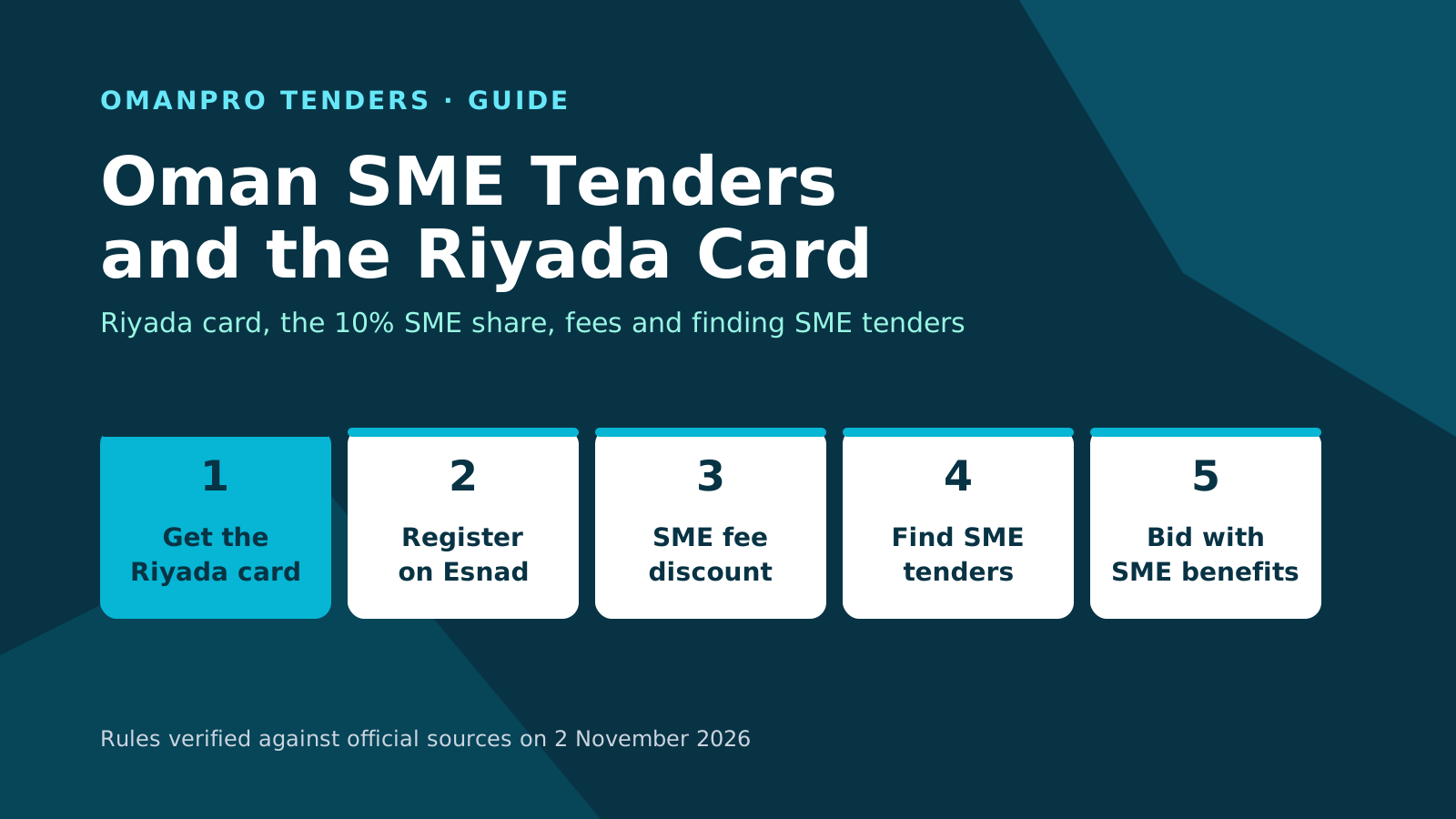
Article 31 of the Tender Law bases selection on the technical and financial criteria in the tender documents. The Board is not bound to accept the lowest bid. Article 36 gives qualifying national products of small and medium enterprises a price preference of up to 10%.
Under Article 29, the tender must be decided and the winner notified before bid validity ends; otherwise, bidders are asked to extend validity. Article 32 requires notification of the winner within one week of award approval. That notice requires the performance bond. The government is not bound by the bid until the contract is signed.
Article 44 requires the winner to provide a performance bond of 5% of the total awarded value within 10 working days from the day after notification. A contractor abroad has 20 working days. The head of the entity may approve an extension of up to 10 days. Consultancy firms provide a professional insurance policy instead.
Under Article 45, failure to provide the performance bond in time may lead to cancellation of the award and forfeiture of the bid bond. Confirm the tender-specific guarantee requirements in the notice or on Esnad.
For tenders up to OMR 3,000,000, Article 15 gives the government entity's internal committee the Board's powers. Check which entity is handling the tender you enter.
Check your tender match
Start with the tender match check. Use it as a starting point, then confirm eligibility and deadlines in the official notice.
For wider context, read the Oman tender market report.
Sources
The sources below were verified on 2 November 2026:
- Tender Law issued by Royal Decree 36/2008, consolidated edition reflecting Royal Decree 83/2020.
- Executive Regulation of the Tender Law, Tender Board Decision 29/2010, issued 25 September 2010.
- Royal Decree 83/2020 amending provisions of the Tender Law.
- Authority FAQ on Esnad.
- Tender Board Decision 104/2022 on classification and registration.
- Tender Board Circular 1/2023 on exemption from the bid bond.
- Tender Board Circular 1/2024 extending the bid bond exemption.
- Royal Decree 57/2025 renaming the Secretariat General of the Tender Board.
- Esnad public tender list.
OmanPro is independent of the official authorities; the official texts prevail.