Executive Summary
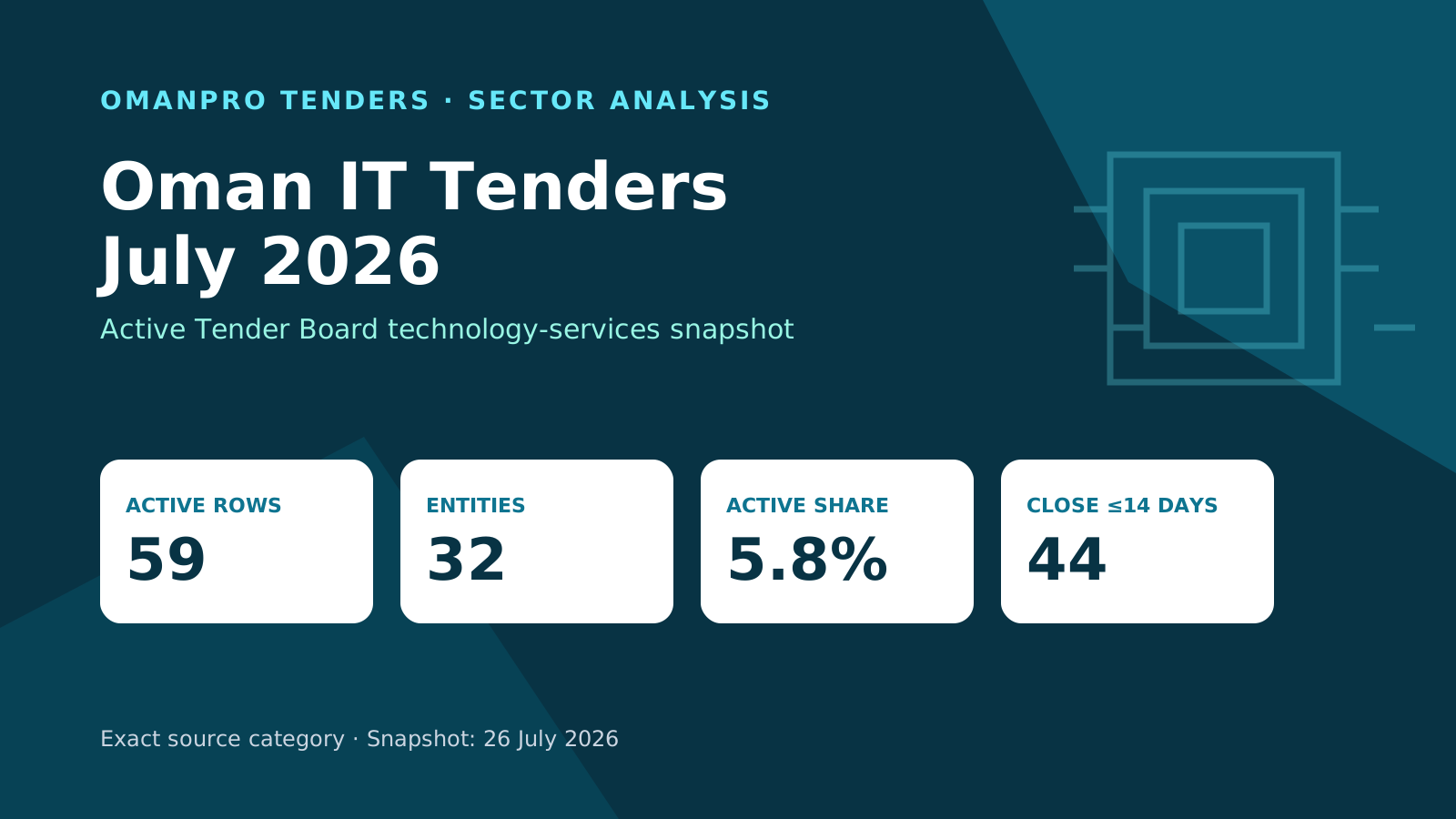
- OmanPro counted 59 active Information Technology Services tenders on 26 July 2026. They represented 5.8% of the 1,014-row active floated snapshot.
- The sector is distributed across 32 publishing entities. The largest single entity contributed only six rows, and the top five together held 21 (35.6%).
- Deadline pressure is high: 44 rows close within 14 days. However, 31 of the 59 already had a stored document-sales end date before the snapshot.
The last point changes how suppliers should read an “active” tender count. A future bid-closing date means the tender remains in the floated list; it does not guarantee that a new bidder can still buy or access the documents.
IT demand is distributed across government operations
The 59 rows use the Tender Board's exact Information Technology Services classification. They span regulators, health, agriculture and food safety, aviation, transport and communications, logistics, banking, consumer protection, tourism and information.
No short fixed watchlist covers this market. Even the five leaders leave 38 rows across other entities, so suppliers need capability-based monitoring across the public sector.
Open tenders lead, with a meaningful SME lane
Open tenders account for 36 rows (61.0%), while 15 are marked for SMEs. Neither label proves suitability: vendor grade, specialization, product authorization, local presence, security requirements and other conditions still need source-document review.
Bid closing and document sales tell different stories
| Bid closing window from 26 July | Active IT rows | Share of 59 |
|---|---|---|
| 0-7 days | 24 | 40.7% |
| 8-14 days | 20 | 33.9% |
| 15-30 days | 11 | 18.6% |
| 31+ days | 4 | 6.8% |
Three quarters of the sector (44 rows) closes within 14 days. But document-sales timing is an additional gate:
| Stored document-sales status | Rows | Share of 59 |
|---|---|---|
| Sales end date before 26 July | 31 | 52.5% |
| Sales end date on or after 26 July | 28 | 47.5% |
A row in the first group may still matter to a supplier that already obtained the documents, but it should not be presented as a newly accessible opportunity. Teams must verify the live notice before acting, especially when the sales end date falls on the snapshot day.
What this means for technology suppliers
Use two stages. First, match capability: infrastructure, software, cybersecurity, devices, licensing, integration, support or other exact requirements. Then apply operational gates: entity, tender type, grade, document-sales date, bid-closing window and internal capacity.
The 19-25 July weekly tender update shows where IT sits within the wider new flow. OmanPro's business-specific tender intelligence turns these checks into a repeatable review queue, while the Oman Tender Market Report provides the broader market baseline.
Methodology, assumptions and limitations
This article analyzes OmanPro's structured sync of the public Oman Tender Board dashboard. The population is lifecycle_status = floated, bid_closing_at >= 2026-07-26, and the exact stored category Information Technology Services. A complete 47-page list refresh finished at 12:01 Oman time on 26 July. OmanPro is independent from Tender Board.
One row equals one opportunity, regardless of value. The category is the source classification; this analysis does not infer technical scope from title keywords or attachments. It does not measure spending, awards, bidder counts or procurement outside Tender Board. A stored sales end date is a screening signal, and the live notice remains authoritative. Exact query definitions and aggregates are preserved in the paired factsheet.