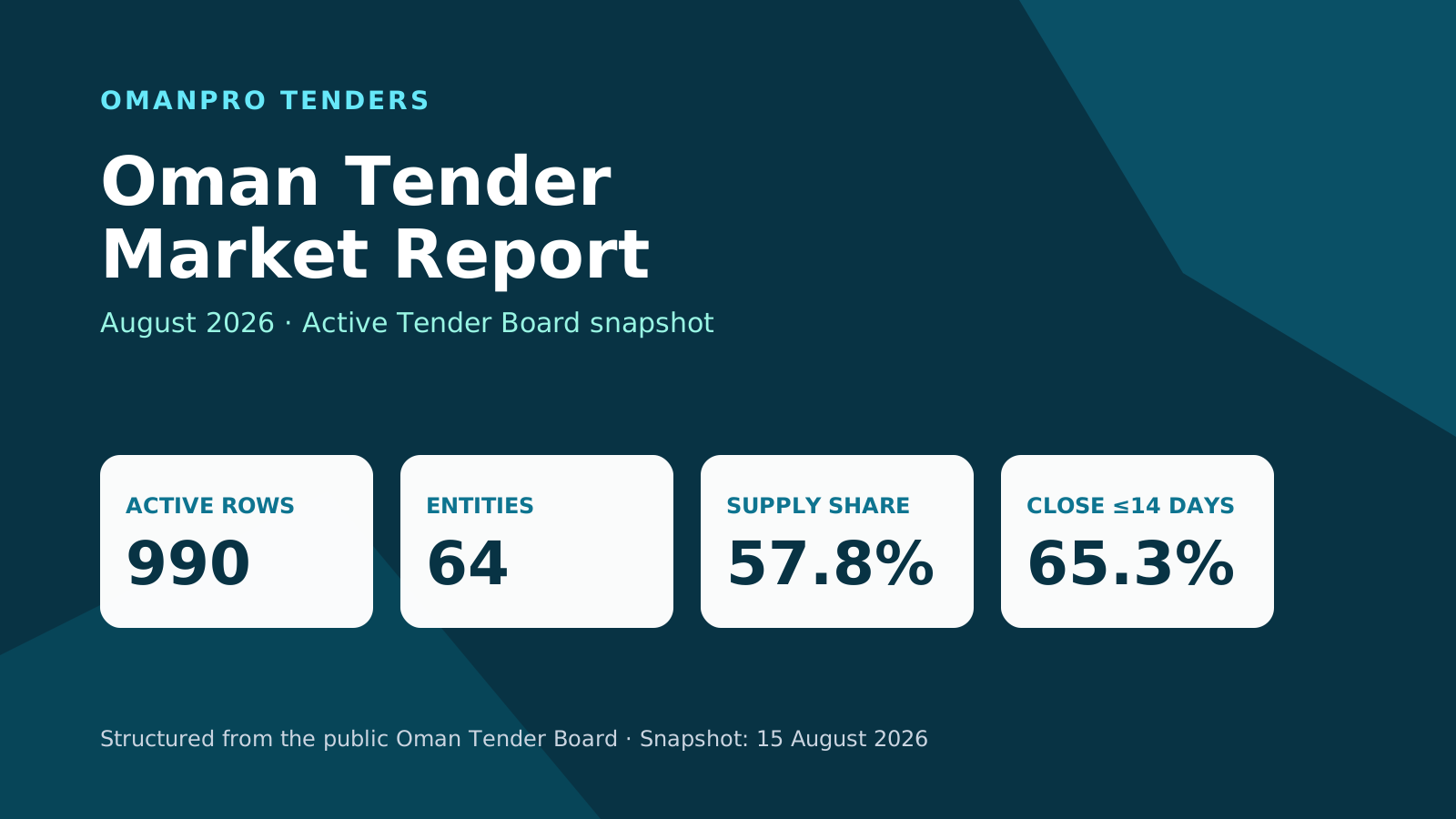

Active Oman Tender Board opportunities are highly concentrated by publishing entity. In OmanPro's 11 July snapshot, 939 floated tenders remained open, and the Ministry of Health accounted for 415, or 44.2%. The top five entities together accounted for 610 opportunities (65.0%); the top ten accounted for 730 (77.7%).
That concentration makes entity monitoring useful, but not sufficient. The same supplier may find relevant work across health, education, municipalities, governorates, universities, and sector ministries. A good pipeline view combines entity coverage with category, tender type, and deadline filters.
Active opportunities by entity
| Concentration measure | Active tenders | Share of 939 |
|---|---|---|
| Ministry of Health | 415 | 44.2% |
| Top five entities | 610 | 65.0% |
| Top ten entities | 730 | 77.7% |
| All other entities | 209 | 22.3% |
Four findings for suppliers
1. Health dominates the count, but 524 opportunities sit elsewhere
The Ministry of Health is the obvious first monitoring lane for medical, laboratory, facilities, maintenance, and general supply businesses. Yet ignoring every other entity would miss 55.8% of the active market. The second group includes agriculture and fisheries, education, higher education, social development, municipalities, governorates, housing, information, and environment.
2. Supply is the largest category, with services and construction still material
| Category | Active tenders | Share |
|---|---|---|
| Supply | 549 | 58.5% |
| Services | 145 | 15.4% |
| Construction and Maintenance | 115 | 12.2% |
| Information Technology Services | 56 | 6.0% |
| Consulting Offices | 24 | 2.6% |
Entity and category should be read together. A construction supplier does not need all 415 Ministry of Health rows; it needs the subset matching its capabilities, grade, location, and preparation window.
3. SME and open opportunities are close in total volume
The snapshot contains 464 SME tenders and 433 open tenders, with 42 rows across international, negotiation/direct award, and real-estate types. SMEs therefore have a substantial dedicated lane, but supplier classification still needs to be checked against the source requirements for each tender.
4. Nearly seven in ten active opportunities close within 14 days
| Closing window from 11 July | Active tenders |
|---|---|
| 0-7 days | 412 |
| 8-14 days | 249 |
| 15-30 days | 202 |
| 31+ days | 76 |
The first two windows contain 661 tenders, or 70.4% of the active list. This does not mean every one is still purchasable: the sales end date can arrive before bid closing. It means entity-level monitoring must be frequent enough to leave time for qualification, pricing, approvals, and document preparation.
What this means for business development teams
Use the leading entities to set monitoring priorities, not to narrow the market permanently. A practical review sequence is: match the requirement to your capabilities, confirm tender type and eligibility, check the sales end date, then assess whether the closing window is realistic. Teams should also track recurring entities even when their current count is smaller; relevance matters more than raw volume.
The 7-11 July weekly tender update shows which entities and categories added fresh rows to this active base.
OmanPro's business-specific tender intelligence uses these market signals as context, then filters opportunities by each company's profile, criteria, and deadlines.
For the broader analysis owner covering categories, supplier types, deadlines, and market concentration, read the Oman Tender Market Report.
Methodology and limitations
This article analyzes lifecycle_status = floated rows with bid_closing_at >= 2026-07-11 in OmanPro's structured copy of the public Oman Tender Board list. The latest successful incremental sync completed at 22:00 Oman time on 11 July. Arabic and English entity labels were grouped through the stored English field. OmanPro is independent from Tender Board.
This is an active-list snapshot, not a measure of total procurement spending, awards, or original publication volume. One tender row is one opportunity regardless of value. Contract values, bid-opening data, awarded outcomes, detail attachments, and opportunities outside the Tender Board source are excluded. The paired factsheet preserves the query definitions and aggregate tables.